
The Supreme Court on Thursday refused to examine a public interest litigation (PIL) seeking a judicial probe into the April 22 Pahalgam terror attack in which 26 people were killed.

A bench of Justices Surya Kant and Joymalya Bagchi is likely to take up the matter in which the EC has justified its ongoing SIR of electoral rolls in Bihar, saying it adds to the purity of the election by "weeding out ineligible persons" from the electoral rolls.
The Supreme Court on Wednesday refused to hear a plea seeking a first information report (FIR) against high court judge Yashwant Varma in connection with the discovery of cash from this official residence in the capital.
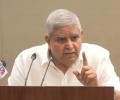
Rajya Sabha member Kapil Sibal has criticised Vice President Jagdeep Dhankhar for questioning the judiciary over the timeline for the president to take decisions, calling it "unconstitutional " and a lowering of the dignity of the chair. Sibal asserted that Dhankhar's remarks are not neutral and amount to an attack on the judiciary by the executive. He also pointed out that the president acts on the aid and advice of the council of ministers, and therefore, the president's power cannot be curtailed. Sibal urged Dhankhar to seek a review of the judiciary's decision or an advisory opinion from the Supreme Court if he has problems with it. He also questioned why Dhankhar only focuses on actions taken during Congress governments and not after 2014.

The Supreme Court of India strongly condemned the terrorist attack in Pahalgam, Kashmir, that killed at least 26 people, mostly tourists. The court observed a moment of silence in tribute to the victims and expressed condolences to their families. The attack was described as an affront to the values of humanity and the sanctity of life. The Supreme Court Bar Association and other legal bodies also condemned the attack and expressed solidarity with the victims and their families.
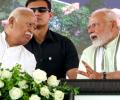
BJP and RSS leaders are once again pushing to remove the words 'secular' and 'socialist' from the Constitution's Preamble, showing a deeper effort to change India's identity from a diverse, multi-religious republic to a Hindu-first nation, even though they don't have the numbers in Parliament to officially change the Constitution, observes N Sathiya Moorthy.

'The long term strategy is that this government wants to create a second class citizen list.'
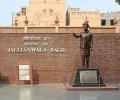
Former Supreme Court judge Justice Rohinton Nariman has warned that events similar to the Jallianwala Bagh massacre could occur if the 'basic structure' doctrine of the Constitution is diluted. In his new book, 'The Basic Structure Doctrine: Protector of Constitutional Integrity,' Nariman argues that the 1973 Kesavananda Bharati judgment, which established the doctrine, is essential for protecting fundamental rights and preventing constitutional amendments that could lead to such tragedies. Nariman's concerns are echoed by Supreme Court judge Justice K V Viswanathan, who applauds the book for its "chilling clarity" and underscores the importance of the Kesavananda Bharati ruling. The book provides a detailed analysis of the doctrine and its implications, highlighting the robustness of the Kesavananda Bharati judgment and the lack of a compelling alternative theory.
While India today is vastly different from the India of 1975, the need for vigilance against authoritarianism remains the same, asserts Utkarsh Mishra.
Bhagwat's 'retirement at age 75' comment lands just as he and Modi near that mark -- sparking whispers of retirement, rifts, and reshuffles.

A bench of Justices Vikram Nath and Sandeep Mehta also restored the destruction of evidence charge levelled on deputy commissioner of police Parampal Singh for directing the removal of the number plate of the car after the firing incident in 2015 in which a driver was killed.

'Vigilance' is a dreaded term for PSB employees and there are instances where this fear is misused by the higher authorities to tame their subordinate officials. This fear always deters PSB executives from making decisions -- the fewer the decisions, the less the chance of falling into trouble, points out Tamal Bandyopadhyay.

The Centre on Wednesday told the Supreme Court that nobody can claim right over government land and it is legally empowered to reclaim properties which are declared waqf by using the waqf by user principle.

Trump has a major decision to take in coming days -- specifically, how to rescue Israel from the attritional war that lies ahead, points out Ambassador M K Bhadrakumar.
The National Investigation Agency has informed a Delhi court that Mumbai attack accused Tahawwur Rana could spill the beans on the ongoing and future terror plans of outfit Lashkar-e-Taiba and its chief Hafiz Saeed for India.

Khedkar is accused of misrepresenting information in her application for the 2022 UPSC civil services examination for availing reservation benefits. She has refuted all the allegations against her.
The Supreme Court of India has reserved its interim orders on three key issues related to the Waqf (Amendment) Act, 2025, including the power to denotify waqf properties, the composition of waqf boards, and the provision regarding government land. The court heard arguments from both the petitioners, who challenged the validity of the amended law, and the Centre, which defended the Act as a secular concept. The petitioners sought interim orders to prevent the implementation of certain provisions while the court considers the legal challenges.

The Supreme Court of India has ordered a progressive reduction in the deputation of Indian Police Service (IPS) officers to Central Armed Police Forces (CAPFs) over the next two years, citing concerns over the delayed promotions of cadre officers. The court's decision aims to address the long-standing grievances of CAPF officers who feel their promotional prospects are hampered by the presence of IPS officers in higher ranks. The ruling also mandates a cadre review of the CAPFs to be completed within six months, addressing the issue of stagnation in the service hierarchy. The court's decision acknowledges the valuable contributions of CAPF officers while also recognizing the need to balance their promotional prospects with the operational requirements of the forces.

A handwritten feedback letter purportedly written by BRS leader K Kavitha to her father and former Chief Minister K Chandrasekhar Rao, highlighting both the negative and positive aspects of the party's recent meeting, has sparked discussions in Telangana's political circles. While the authenticity of the letter has not been confirmed, Kavitha's letter suggests that the party might be aligning with the BJP. She also criticized KCR for his silence on key issues such as 42 per cent reservation for backward classes, Scheduled Castes categorisation, and omission of Urdu from his address at the BRS Silver Jubilee event.

Aiden Markram himself knows what he is capable of -- and how to express it on a cricket field. And South Africa will be the biggest beneficiary in the coming years.
Preventive detention is an extraordinary power in the hands of the state that must be used sparingly, said the Supreme Court as it set aside an order to detain a man indulging in money lending in Kerala.

Saying the law doesn't recognise the concept of marital rape, the Delhi high court has quashed an order directing prosecution of a man for performing 'unnatural' sex with his wife.
The woman is a student of MA and hence she "was competent enough to understand the morality and significance of her act", stated the order passed by Justice Sanjay Kumar Singh last month.
Underscoring the 'presumption of constitutionality in favour of law', the Supreme Court on Tuesday said petitioners challenging the waqf law needed a 'strong and glaring' case for interim relief.

Supreme Court judge, Justice B R Gavai, expressed hope that the "current difficult phase" in ethnic strife-torn Manipur will be over soon with the assistance of the executive, legislature and judiciary and the state will prosper like the rest of the country. Justice Gavai, who led a delegation of Supreme Court judges that visited Manipur, called upon the people of the state to work together to restore peace and harmony. He also urged the people of the state to work together to restore peace and normalcy, and lauded the natural beauty he witnessed while travelling from Imphal to Churachandpur. He expressed delight in noting that training programmes were being imparted at the relief camps, and thanked the Chief Justice of Manipur High Court and the district legal services authority for their efforts. Justice Gavai also stressed the need for readmission of students who had to drop out of school due to the conflict and called upon the educational institutions and the public to ensure all students complete their education.
The Supreme Court of India has reprimanded a Karnataka High Court judge for passing an inconsistent verdict, highlighting the crucial importance of consistent judicial outcomes for maintaining public trust. The court emphasized that inconsistent decisions from different benches undermine faith in the judiciary and can lead to "forum shopping" and other unethical practices.
The Supreme Court of India has ruled that governors cannot indefinitely delay giving assent to bills passed by state legislatures, setting a timeline of one to three months for their actions. The court said the governor must act "as soon as possible" and that failure to comply with the timeline will make their inaction subject to judicial review. The ruling comes as several opposition-ruled states have accused governors of delaying assent to bills passed by their assemblies.

Inter Kashi to appeal the decision to CAS.

The top court also referred to the distinctions achieved by women officers, and put out an example of Col Qureshi's achievements.

'I am not 100 percent okay even now. Have to give it my all because many livelihoods depend on my work.'

The Delhi High Court has ruled that the rights of an overseas citizen of India (OCI) cardholder cannot be arbitrarily curtailed, stating that the deportation and blacklisting of a US citizen holding an OCI card, accused of unauthorized missionary activities, did not follow proper statutory procedure. The court emphasized the need for natural justice, requiring an opportunity for the individual to be heard and contest the allegations before any action is taken.
At the end of the day, for many worldwide, the ongoing mutual attacks between Israel and Iran would seem a contest devoid of any moral high ground and only a bout between two ordinary adversaries, one that nevertheless risks spinning out of control into a larger conflagration, notes Shyam G Menon.
Supreme Court Bar Association (SCBA) president Adish C Aggarwala Thursday wrote to Chief Justice of India D Y Chandrachud expressing "shock" at an open letter to the head of the judiciary by a senior member of the bar.

We must heed what the CJI has said. Challenging every judgment of the central government is inviting chaos, asserts Shreekant Sambrani.
The Supreme Court of India has sought the government's response on a Public Interest Litigation (PIL) that challenges the appointment process of the Comptroller and Auditor General of India (CAG), arguing it's unconstitutional. The PIL, filed by the Centre for Public Interest Litigation, claims the current process, solely through executive appointment by the Prime Minister, undermines the CAG's independence and violates constitutional principles. The court, while acknowledging the importance of institutional trust, questioned the extent to which it should intervene in the appointment process and whether this would constitute rewriting constitutional provisions. The PIL suggests the CAG's appointment should be similar to other independent bodies, with a selection committee comprising the Prime Minister, Leader of the Opposition, and Chief Justice of India. The case has implications for the independence and transparency of India's audit system.

If a woman can fly Rafale fighter jet in the Indian Air Force, then why are fewer women officers in gender neutral posts of judge advocate general (legal) branch of the Army, the Supreme Court wondered recently and questioned the Centre's rationale on a 50-50 selection criterion.

Israel's aerial assault on Iran is widely viewed as an act of naked aggression with no basis in international law, carried out unilaterally despite US opposition and aimed at derailing ongoing US-Iran nuclear negotiations, observes Ambassador M K Bhadrakumar.

The HC said this while dismissing a petition by Taufik Ahmad who had sought quashing of proceedings against him on charges of rape and unlawful religious conversion of a Hindu girl to Islam through misrepresentation under the UP anti-conversion law.

The bench, which examined the online post by the professor, who heads the political science department in the Sonipat-based Ashoka University, questioned his choice of words, saying they were used deliberately to humiliate, insult, or put others in discomfort. "The choice of words are deliberately made to insult, humiliate or cause discomfort to others. The professor, who is a learned person cannot lack a dictionary... he could have conveyed the very same feelings in a simple language without hurting others. He should have shown respect for the sentiments of others. He could have used a simple and neutral kind of language, respecting others," Justice Kant said.

'Nobody expected it to become a landmark judgment.' 'Because the Supreme Court has expanded the definition of family and included single parents, same sex parents, etc, the scope of looking at families has enhanced.'
